
How to Take Control of Your Life
How to Take Control of Your Life – Control Your Life
Not knowing what to do. Find out how to take control of your life. Discover reasons, powerless feelings and behaviors to take.
At some point in our lives, we all have experienced the feeling that life is something that is done to us, as opposed to being done by us. It might be because of unforeseen health conditions, occupational stress or certain personal problems, but that feeling of powerlessness may be overwhelming.
But psychology informs us that overseeing your life is not merely a slogan; it is an important part of your physical and mental health.
Theories such as the locus of control and self-efficacy are extremely significant in dealing with stress. To improve coping abilities, health and reduce anxiety, intensifying your feeling of control might help.
What Does it Mean to Feel in Control?
In psychology, the sense of being in control of your own journey is spelt out by some concepts. Knowing them would assist you in locating your location.
Sense of Control (Perceived Control): This is the perception that your control affects your events in life. It is a negation of the theories of your destiny or your fortune being predetermined.
Locus of Control: This is a measure of the level of control that you possess. A locus of control of internal will make you think that your decisions produce a result. When it is external, then you just point the finger at fortune or at other individuals.
Self-Efficacy: This is the opinion about your capacity to succeed. It is a significant motivation force. An example would be self-efficacy in action when you think that you can follow an exercise program.
Why Are We Losing Our Control?
According to research, the low sense of control is hardly the result of one event. It is normally an accumulation of various factors that contribute to it.
Early Life and Trauma
Your history matters. If you grow up in uncertain conditions or if those you depend on undermine your sense of security, you may develop a feeling of helplessness, which you believe you have learned. In the same manner, traumatic experiences or unstable living conditions can make outside influences seem to motivate your life.
Mental and Physical Health to Take Control of Your Life
Some mental health disorders, including depression or anxiety, are closely associated with powerlessness. Physical health issues may also destroy your thinking that what you do is important, particularly when they decrease your independence or physical activity.
Social Factors
Continuous discrimination, poverty, or unstable working conditions may make it extremely hard to grasp control over your life. When there are systemic obstacles, there is an intuitive response that you have no control over the outcomes.
Symptoms: You May Be Losing Control.
Powerlessness is not a medical condition, but it tends to manifest itself in particular ways in the way you think, feel, and behave.
Cognitive Signs: You may have problems with chronic pessimism. Common are such frequent thoughts as nothing I do matters or things just happen to me.
Signs Emotional: Major signs include increased distress. You can be nervous, desperate, or have no inspiration.
Behavioral Symptoms: In instances where individuals develop an external locus of control, they tend to retreat. You may find yourself evading trouble, not taking good care of yourself or even taking medications.
Social Signs: You can overly depend on other people to make your choices or remain in bad condition since you think that you are not able to change.
Who Is Most at Risk to Take Control of Your Life?
A sense of agency may be lost by anyone, though there are factors that predispose it.
Personal History: You are more vulnerable to depression, anxiety or low self-esteem.
Environment: Your faith in yourself can be destroyed by chronic financial stress, unstable housing or witnessing violence.
Relationship: The relationships that are controlling or unsupportive may lead to the degradation of your autonomy.
Chronic Illness: When you have a serious illness and particularly one with an unpredictable symptom set or with a complicated regimen, such diseases can cause your body to feel like it is working against you.
How to Begin to Take Control of Your Life.
Health professionals and behavior scientists point out that you can regain your feeling of control. The following are evidence-based measures to assist you in becoming a starter.
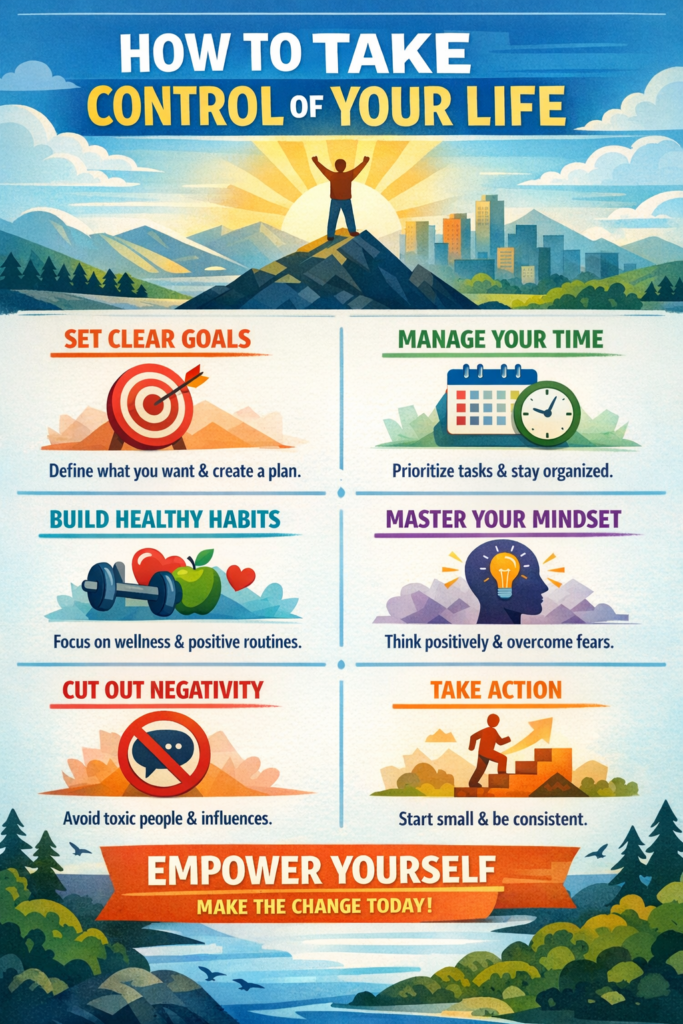
Set Small, Achievable Goals
Radical transformations are debilitating. Rather, divide huge objectives into small steps. Making these small gains generates mastery experiences, which are strong self-efficacy stimulants.
Problem-Solving Skills Construction.
Pay attention to the acquisition of certain coping skills. Decision-making and self-management programs can also assist in changing your attitude towards being external to internal, and this makes it less difficult to adhere to healthy habits.
Enhance Your Health Literacy.
Knowledge is power. Knowledge about your health condition and treatment options will make you feel like you are more competent. When you add this knowledge with self-belief, then you will be more likely to do some preventive care and physical activity.
Requesting Favorable Conditions.
As much as possible, be around individuals and environments that do not interfere with your independence. Being a part of the decision-making concerning your life, either at work or in healthcare, will assist you in perceiving your actions as productive.
Therapy and Technical Assistance.
In case you are finding it difficult to cope, the help of a professional can make a difference. Such are highly documented in mental health research.
Psychological Therapies
Cognitive Behavioral Therapy (CBT) helps you to identify and replace unhelpful thoughts with other ones, such as global helplessness. It teaches some of the most effective coping mechanisms, which can make the symptoms of anxiety less pronounced and make you more stable.
Skill-Building Interventions to Take Control of Your Life
Skills and task-oriented therapies are very effective. They also give feedback on the progress which is crucial in changing behavior, such as smoking termination or chronic disease management.
Stress Management
Mindfulness and relaxation training are some of the techniques that can enhance your capacity to control your emotions. One of the main aspects of being in control of your external life is to manage your own reaction.
Medical Management
If the low sense of control is connected to a mental illness, evidence-based interventions such as psychotherapy or medication can be a good option. Perceived control will naturally increase with the improvement of the underlying symptoms.
Conclusion
To be in control of your life, in fact, is a process, not a place. Furthermore, the studies always reveal that a high level of personal power and self-efficacy results in improved mental state and physical health.
Development of these characteristics is time-consuming. It is made up of personal approaches such as goal setting and skill acquisition and seeking the appropriate social support. In case distress is messing up your day-to-day life, contact a professional. You do not need to figure this out by yourself.
Frequently Asked Questions
Q1. Should my life always be healthy to want to be in control of it?
The desire to have a certain control is a natural human need that is healthy. Rigid perfectionism or excessive control, however, may enhance stress levels and may indicate anxiety.
Q2. Is it possible to have a change in the locus of control?
Yes. Although these personality traits are rather stable, they may change. You can also cultivate a more internal locus of control with time by means of new experiences, therapy, and learning new skills.
Q3. Does the feeling of being out of control imply I am a mentally ill person?
Not necessarily. It may take place in stressful situations without a diagnosable disorder. But if you persistently feel helpless or find it interfering with your daily functioning, this feeling may point to a deeper situation and signal the need for further exploration.
Q4. Are more controllable individuals living healthier?
Generally, yes. People who engage in positive health behaviors, such as exercising regularly and managing chronic diseases, tend to have higher levels of self-efficacy and an internal health locus of control.
Q5. Does this data substitute for doctor visits?
No. It is an educational article. It cannot assess your individual situation. The diagnosis and the decision to be made should always be discussed with a qualified healthcare professional.
Disclosure: The paper is informative in nature, general and in no case a substitute for personal medical attention. In case of trouble, a competent medical expert should be approached.